
Your Baby Wears Plastic Every Day. What's in That Diaper?
By Sandra Zalas
Disposable diapers offer convenience, but understanding their material composition, particularly concerning chemicals like phthalates, is key for informed parenting. Recent research highlights how these substances can be absorbed through an infant's skin.
Your Baby Wears Plastic Every Day. What's in That Diaper?
The short answer: Most disposable diapers contain several types of plastic, along with materials designed to keep babies dry. Researchers have also found traces of potentially harmful chemicals in some diapers. That doesn't mean disposable diapers are inherently dangerous, but it does make the materials worth looking at. If you're buying diapers, start with fragrance-free options and brands that disclose what goes into them.
It's 3 a.m. You're changing a diaper with one eye open, trying not to wake the baby you've just spent an hour getting to sleep.
You reach for another one. Soft, white, absorbent. Maybe the packaging says pure, natural or cloud-soft.
Have you ever wondered what that softness is actually made of?
Because a disposable diaper is a surprisingly sophisticated piece of plastic engineering.
What's inside a diaper?
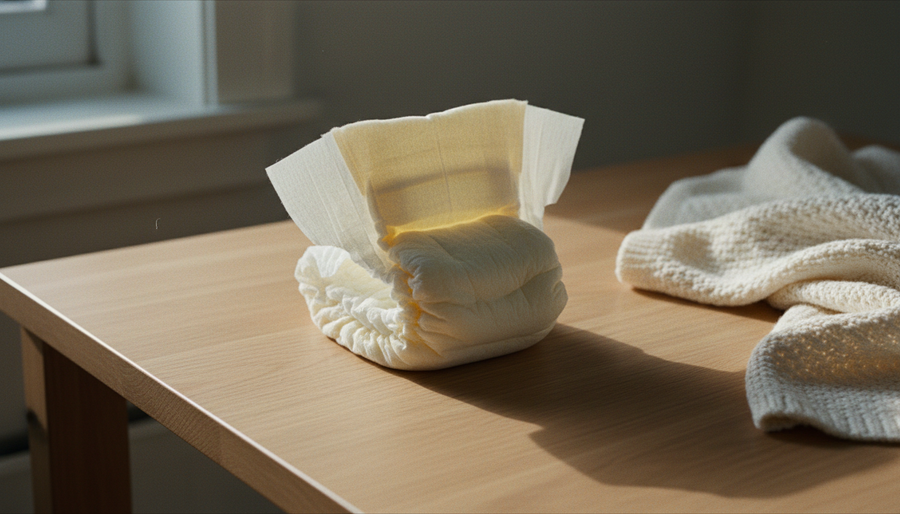
Peel apart an ordinary disposable diaper (preferably an unused one) and you'll find several layers doing different jobs.
The layer against your baby's skin often contains polypropylene, a plastic also used in food packaging and textiles. The waterproof outer layer commonly uses polyethylene. Inside, there's usually wood pulp mixed with sodium polyacrylate, a superabsorbent synthetic polymer that swells into a gel when wet.
That gel is actually useful. It helps keep moisture away from the skin, reducing irritation.
But it's interesting how rarely we talk about all this plastic.
We scrutinize baby bottles, toys and clothing labels. Meanwhile, here's a product spending hours against some of the most sensitive skin on the body.
What have researchers found?
In 2023, scientists examined 31 disposable hygiene products sold in the United States, including baby diapers and wipes.
They detected various volatile organic compounds (VOCs), including traces of benzene and 1,4-dioxane in some baby diapers.
These chemicals aren't microplastic particles. They're chemical contaminants, and their presence doesn't automatically tell us how much reaches a baby or whether that amount causes harm.
Still, they're not exactly ingredients you'd expect to find in a product designed for newborns.
Then, in 2025, researchers in China studied disposable diapers and urine samples from 66 infants.
They found phthalates in diapers and observed a relationship between one phthalate measured in the diapers and its breakdown product in the infants' urine.
Phthalates are a family of chemicals, some of which are used to make plastics flexible. The study also found associations with a biological marker of oxidative stress.
It didn't establish that the diapers caused that cellular stress, or that the measured chemicals came exclusively from diapers. Children encounter phthalates through other sources too.
But it gives us something concrete to investigate: what transfers from a diaper to a baby's skin, and how much?
Didn't regulators already look into this?
Yes, and the story is worth knowing.
In 2019, France's food and environmental safety agency, ANSES, raised concerns about undesirable chemicals detected in disposable baby diapers and called for action.
Manufacturers came under greater scrutiny.
Follow-up government testing in 2020 found improvements, with no exceedances of the assessed health thresholds in the products tested.
That's encouraging. It also shows why independent testing matters. Products can improve when someone actually checks what's in them.
So which diapers would I choose?
I wouldn't start by throwing away an entire box.
I'd start with the packaging, and perhaps the manufacturer's website.
Can you find out what the inner layer is made of? Does the company disclose fragrances, lotions and other added substances? Does it publish meaningful chemical-testing information, rather than relying on words like natural?
My preference would be a fragrance-free diaper from a manufacturer that's transparent about its materials and testing.
What about cloth diapers? They're a reasonable alternative to explore, especially if you want to reduce disposable plastic waste. But not every reusable diaper is plastic-free. Many use polyester linings or waterproof synthetic covers.
And keeping your baby's skin clean and dry still comes first. The American Academy of Pediatrics points out that absorbency and frequent changes are important for preventing diaper rash.
There's no prize for making an already exhausting part of parenting more complicated.
A better diaper aisle, please
Here's what bothers me most.
We're sold diapers covered in promises about softness, purity and love. Lovely illustrations of clouds, leaves and sleeping babies.
But try finding a straightforward explanation of every material inside one.
For something a child may wear thousands of times, that seems like a reasonable thing to ask.
I'd like to see diapers with clear material information, independent test results and fewer unnecessary additives.
Until then, I'm reading past the clouds on the packaging.
---
Sources
- Infants’ Dermal Exposure to Phthalates from Disposable Baby Diapers and Its Association with DNA Oxidative Damage. Toxics, 2025.
- Volatile Organic Compounds in Disposable Diapers and Baby Wipes in the US: A Survey of Products and Health Risks. Environmental Science & Technology, 2023.
- ANSES: Safety of Baby Diapers. French Agency for Food, Environmental and Occupational Health & Safety, 2019.
- French Government: Follow-up Testing of Chemical Substances in Baby Diapers. DGCCRF, 2021.
- Common Diaper Rashes & Treatments. American Academy of Pediatrics.