
The Microplastic Myth: How Much Plastic Are We Really Ingesting?
By Sandra Zalas
The widely circulated claim that humans ingest a credit card's worth of microplastics weekly has been re-evaluated by recent science. While we do consume microplastics, the actual amounts are significantly smaller than often reported, offering a more grounded perspective on our daily exposure.
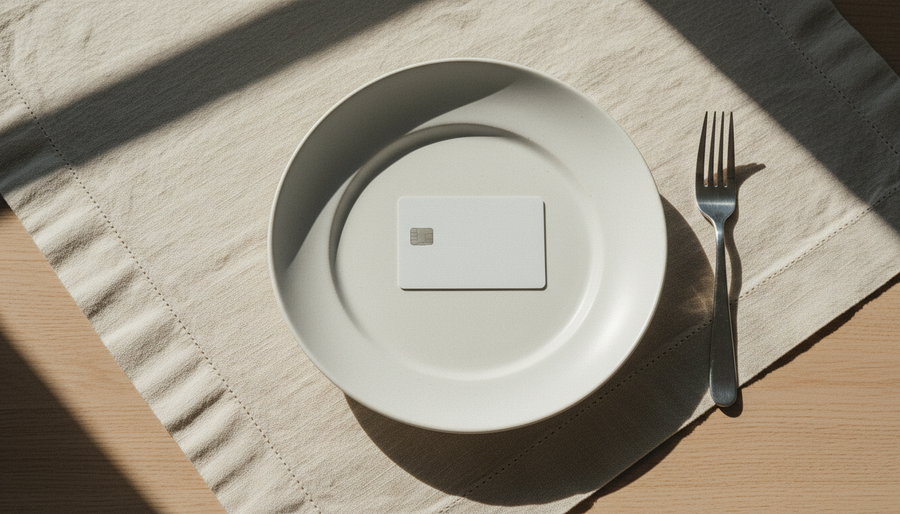
Are We Really Eating a Credit Card of Plastic Every Week?
The short answer: Probably not. The famous claim that we swallow five grams of plastic every week came from an estimate that scientists have since seriously challenged. We're exposed to microplastics through food, water and air, but there's no reliable evidence that the average person consumes a credit card's worth every week.
Imagine someone grating a Visa card over your dinner.
Not particularly appetizing. But that's essentially the image we've been carrying around since 2019, when the World Wide Fund for Nature (WWF) announced that people could be consuming about five grams of plastic every week.
One credit card. Every seven days.
The claim appeared in headlines, documentaries, social media posts and countless conversations about microplastics. It was memorable, slightly horrifying and incredibly easy to repeat.
There was just one problem.
The maths behind it didn't hold up particularly well.
Where did the credit card come from?
In 2019, WWF released a report based on research from the University of Newcastle in Australia.
The researchers had looked at existing studies of microplastics in things we consume, including drinking water, shellfish, salt and beer.
But they weren't collecting and weighing the plastic inside actual people.
They were working with estimates.
Researchers took information about the number of plastic particles detected in different samples and tried to calculate how much those particles might weigh.
Which sounds reasonable until you remember that microplastics aren't all the same size.
A tiny plastic fragment and a much larger one might each count as a single particle, but they can have wildly different masses.
When you're estimating the weight of something microscopic, small mistakes in assumed dimensions can produce enormous errors.
And that's where things got interesting.
Scientists checked the maths
In 2021, researchers published another model of human microplastic intake. Their median estimate for adults was 583 nanograms per day, equivalent to roughly 4 micrograms per week.
That's not five grams. It's dramatically less.
The estimate included dietary intake and inhalation, and it wasn't a direct measurement of what any individual person consumed. But it demonstrated just how differently the numbers could turn out.
Then, in 2022, materials scientist Martin Pletz examined the calculations behind the credit-card claim.
He found serious problems with the assumptions about particle size and the way results from different studies had been combined.
His conclusion? The original approach had likely overestimated the mass of ingested microplastics by several orders of magnitude.
Even WWF updated its original article in October 2024, acknowledging that scientific knowledge had moved on and directing readers toward newer research.
In April 2026, an Australian government health report revisited the controversy and confirmed that the five-gram figure remains highly contested.
So, we can stop worrying about microplastics?
Not quite.
The credit-card comparison might be a terrible measuring tool, but plastic particles in our food, water and air are a real subject of scientific investigation.
And weight isn't necessarily the most useful way to understand exposure anyway.
Think about it. Would you rather swallow one relatively large particle or thousands of much smaller ones? The answer isn't something you can work out from their combined weight alone.
Size, shape, polymer chemistry and how particles interact with the body all matter.
That's why better measurements are worth fighting for.
What I'm taking from this
I'm not particularly interested in buying a microplastic detox product or trying to calculate how many imaginary credit cards I've eaten this month.
I'd rather know which everyday products actually shed particles, under what conditions, and what manufacturers are doing about it.
We can choose materials that release less unnecessary plastic. We can demand better testing. And we can stop repeating numbers simply because they sound spectacular.
Plastic pollution is a real problem. We don't need questionable statistics to make it interesting.
And if someone tells me I've eaten a credit card this week, my next question isn't how to detox.
It's: who weighed it?
---
Sources
- WWF: No Plastic in Nature — Assessing Plastic Ingestion from Nature to People, 2019.
- Senathirajah et al.: Estimation of the Mass of Microplastics Ingested, Journal of Hazardous Materials, 2021.
- Mohamed Nor et al.: Lifetime Accumulation of Microplastic in Children and Adults, Environmental Science & Technology, 2021.
- Pletz: Ingested Microplastics: Do Humans Eat One Credit Card per Week?, Journal of Hazardous Materials Letters, 2022.
- WWF: Updated Statement on Plastic Ingestion, 2024.
- Australian Government: Microplastics and Health Report, 2026.