
Should You Throw Away Your Plastic Cutting Board?
By Sandra Zalas
Plastic cutting boards can release micro- and nanoplastic particles during normal use. But does that mean you need to throw yours away today? Here’s what recent studies found, what they didn’t, and how to make a sensible decision in your own kitchen.
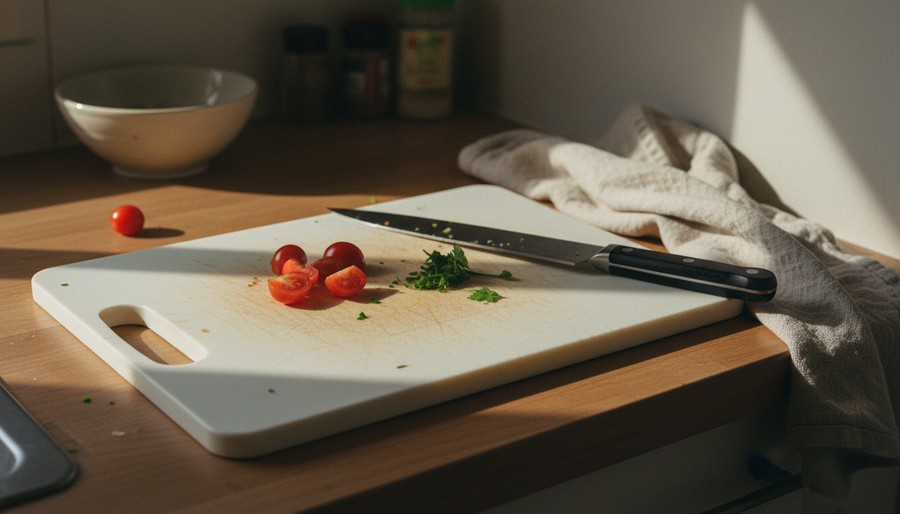
Should You Throw Away Your Plastic Cutting Board?
The short answer: If your plastic cutting board is heavily worn or deeply scratched, we'd consider replacing it. If you're buying a new one, we'd choose a good wooden board. But you don't need to replace everything in your kitchen overnight.
Your cutting board has probably survived hundreds of dinners. Chopped onions, hurried breakfasts, the occasional cooking disaster. It's cheap, practical, easy to clean, and not particularly interesting.
Until you learn that every time your knife meets that plastic surface, tiny particles may be making their way into your food.
Suddenly, an ordinary kitchen object looks a little different.
What happens when we chop on plastic?
In 2023, researchers at North Dakota State University investigated how plastic cutting boards release microplastics during chopping.
They found that both polyethylene and polypropylene boards shed particles. Under their experimental conditions, the researchers estimated that regular use could generate millions of microplastic particles over a year.
And it isn't only about vegetables. An earlier study examined contamination of chicken and fish associated with plastic cutting boards used during food preparation.
Then, in July 2026, another study added an interesting twist: plastic cutting boards may release much smaller nanoplastic particles through mechanisms more complicated than simply shaving fragments from the surface.
The takeaway? Plastic cutting boards are not quite as static as they appear.
They wear. And some of that wear can end up in food.
So, what should you do with yours?
If your plastic cutting board is deeply scratched, flaking, or heavily worn, replacing it is a sensible step.
If it's still in good condition, you can plan to make the switch rather than feeling you need to overhaul your kitchen tomorrow.
One important detail: even a board that looks smooth can release microscopic particles. Visible damage isn't the only indication of shedding.
Our preference for your next board is a good-quality wooden one.
Maple, beech, and walnut are practical options. A well-made board can last for years, and many wooden boards can be refinished as they wear.
Bamboo is another option, although its construction and adhesives deserve attention. Glass and stainless steel avoid a plastic cutting surface, but they're hard on knives and less comfortable for everyday chopping.
Whatever you choose, proper cleaning and food hygiene still matter, especially when handling raw meat or poultry.
And if a new board isn't in your budget right now? That shouldn't exclude you from trying to make better choices.
The bigger question
For years, we've evaluated kitchen products by price, convenience, durability, and hygiene.
Perhaps it's time to add another question:
What does this object release as we use it?
That's a question for manufacturers as much as consumers.
We want a future where better everyday materials are normal, affordable, and designed to last. Not a world where everyone feels guilty about the contents of their kitchen drawers.
Sometimes progress starts with one ordinary object and a better choice when it's time to replace it.
Use better. Keep longer. Replace for a reason.
Sources
- Yadav, H. et al. (2023). Cutting Boards: An Overlooked Source of Microplastics in Human Food?. Environmental Science & Technology.
- Habib, R. Z. et al. (2022). Microplastic Contamination of Chicken Meat and Fish through Plastic Cutting Boards. International Journal of Environmental Research and Public Health.
- Wang, M. et al. (2026). Oligomer self-assembly is a major source of nanoplastic release from household plastic cutting boards. Communications Materials.